Ionic Bonding

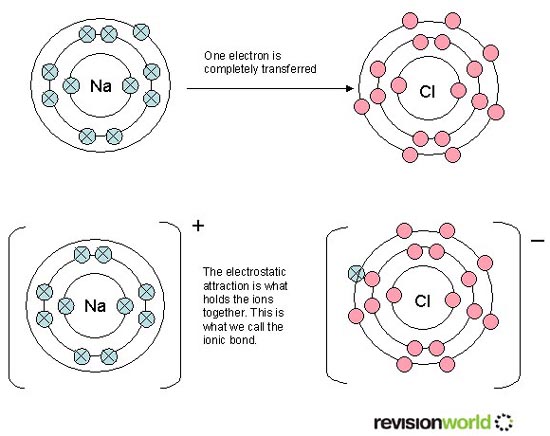
an ionic bond is formed through the electrostatic attraction between two oppositely charged metal + non-metal ions. 

Basically: 

A non-metal atom has, say 'F', amount of electrons they need to gain to get a full outer shell;

    and the metal has 'F' electrons that it needs to lose to get a full outer shell...

....so the metal hands over its 'spare' electrons so that it can be a happy, full, positive metal ion

and the non-metal accepts them become a happy, full negative non-metal ion


what holds them together is the electrostatic attraction, which is what we call the ionic bond


How to draw the 'dot and cross' diagram:
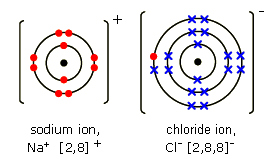
Use this type of diagram: DOT AND CROSS IN BRACKETS!

in the exam, when asked a question about ionic bonding.

(you really only need to show the outer shell electrons...doing the other shells justs wastes time...)

  1. use dots to represent one of the ions' electrons, crosses to represent the other's.
  2. start by drawing dots to represent the electrons in the non-metal how you'd see them without the ionic bond. (remember to pair them up!) Do not draw any electrons in the outer shell of the metal - these have now been transferred to the non-metal.
  3. now think. how many electrons have been transferred? use crosses to draw the remaining outer shell electrons that would have come from the non-metal into the shell of the metal ion. 
  4. Now add the charges: how many electrons has the metal lost? if 1, put a +  symbol to the top left of the bracket, if 3: 3+; 4: 4+ and so on...
  5. if you have magnesium chloride, magnesium is in group 2 (and so Mg2+) and chlorine is in group 7 (Cl-) the compund you would get is MgCl2, the way you would draw this is, no e- in Mg's shell, and one extra e- in the chlorine shell even though you have 2 electrons from magnesium... you just put a '2' infront of the chlorine bracket, to show that theres 2 of them :)
  6. and you're done! Smile! :D


    http://www.revisionworld.co.uk/gcse/chemistry/classifying-materials/bonding/ionic-bonding http://www.bbc.co.uk/schools/gcsebitesize/science/add_aqa/atomic/ionicrev5.shtml

    This free website was made using Yola.

    No HTML skills required. Build your website in minutes.

    Go to www.yola.com and sign up today!

    Make a free website with Yola